Saving the World Starts in Africa
In the face of a global economic catastrophe, I’m not paying much attention to the news. “Our leaders” are lying like always. Sure, there’s Big Changes ahead—but scaremongering and cynicism are a waste of precious life. I’m actually more optimistic these days than I’ve ever been, and it’s all because of Africa. The most innovative solutions and inspirational success stories I’ve found are coming from the Mother Continent, and I can’t imagine a better remedy for American Fear than this. No matter what kind of nightmare collapse scenario you can imagine for the United States, Africa has already been there and back.
Africa has insane problems. Most of them are thanks to Europe, the US, and China. From the nightmare captialism of King Leopold to the 5.4 million dead in the wake of the Second Congo War, the connections between First World invasions and ongoing problems is never less than obvious. The second wealthiest nation in the world, Equatorial Guinea, remains a poverty-stricken wasteland despite a GDP of over $12 billion. (Population? Just over 500,000 people, which is smaller than the state of Vermont.)
I should also mention that nearly 75% of all AIDS deaths happened in the southern half of Africa, but I’m done with the brutal facts for the rest of this article. I’m not laundry listing statistics to stun you into helpless depression, just giving a quick overview. I firmly believe that saving the world starts in Africa. I’d like to invert our assumptions and look at things differently—how can problems be opportunities?
Autonomy, Not Government
On the face of things, the lack of infrastructure is a huge problem, right? I’m going to disagree. Here in the United States, our infrastructure is the problem. We have failed strategies and designs literally built into our environment on a national level. Our energy dependence on petroleum, for instance, has reduced the world’s richest nation to the brink of collapse.
Rather than moaning about the sheer cost of building Africa up “to our level,” it’s worth considering that “our level” is not an advancement, but a mistake. Africa has the opportunity to start with a clean slate and do things right. This is often referred to by tech-heads as “Leapfrogging”—here’s a great summary from the amazingly good book Worldchanging
Developing nations don’t have to play catch-up: they can adopt new technologies and tools—not always from the West—and use them in their own ways, skipping old or outmoded methods and embracing brand-new ones…
Leapfrogging means more than simply adopting new gadgets. The red-hot core of the concept is freedom. Being poor or lacking access to to established technologies can liberate individuals and communities to embrace the new, because they haven’t yet poured money into the old.”
Let’s be blunt: the World Bank and the IMF want Africa to serve them. It has nothing to do with African independence. The contracts and terms are clearly engineered for maximum profit—and this has been clear for over a decade. The history of Africa is the fight for human freedom, from Steve Biko to Emperor Haile Selassie I. (Side note: If you’re not familiar with long, strange connection between the United States and Liberia, get familiar.)
Anarchy is not violence, folks. Ghandi was an Anarchist of sorts—the proper term is philosophical anarchism. Ghandi didn’t respect state power, but he wasn’t rushing to destroy it, either: “The state evil is not the cause but the effect of social evil, just as the sea-waves are the effect not the cause of the storm. The only way of curing the disease is by removing the cause itself.”
Due to resource imbalances, humans are unable to live in peace on Earth these days. The solution to this problem is not more government—it’s closer to John Robb’s recent work on Resilient Community.
Empowerment, Not Jobs
“The most effective vaccine against child death in Africa is a glass of clean water.” Kevin Watkins, author, UN HDR, 2006
Technology needs to be open source. If I figure out how to extract drinkable water from the air, for example, my first thought is not “how can I make money off this,” but rather “how can I get this spread as widely as possible in the shortest amount of time?”
DISCLAIMER: I disagree with most Western economists on the issue of jobs. A “job” only adds value if it contributes to the culture and makes the employee into a better person. 1. If someone is working at a Taco Bell, I think that works against the entire culture. It makes people hate life and contributes to world problems, and it doesn’t pay you much either. 2. More cops on the street does not add value to a culture—it just leads to more arrests, as surely as passing laws only leads to more laws. Again, bureaucracies, governments and corporations are not a solution, they are an ongoing and serious problem. I’m open to conflicting evidence—if you know of government or corporate good deeds in Africa, let me know.
Don’t believe me: just check out Forbes Magazine, folks. They’re reporting that “renewable energy” not only saves money, it has also “generated about 90,000 jobs.” Fast Company has two good recent reads I recommend: first, an entertaining look at the hard work of Van Jones, and second, a cautionary tale about William McDonough.
Erik Hersman puts it much more bluntly: “Our challenge is to get people to realize that there is a real competitive advantage to developing and testing software in Africa. After all, if it works in Africa, it will work anywhere.” He should know: he’s one of the designers behind the Ushahidi system, a truly amazing platform for “Crowdsourced Crisis Information”—learn more here.
The Hippo Roller is another great example of truly useful design. It provides a solution without depending on any other infrastructure or technology. Check out this excellent photojournal about Project H for an example of how the Hippo Rollers can be distributed and re-used on the ground level.
Solutions, Not Products
“Women produce more than half of all the food grown worldwide, yet own only two per cent of all land and get only one per cent of lending to agriculture.”—Gawain Kripke
Poor people aren’t poor because they don’t have money.
They’re poor because they need to get money in order to live a decent life. They’re poor because they’re surrounded by too many people and not enough resources. They’re poor because they’re stuck in areas that nobody wants to be, and they don’t have any alternatives. And 10 times out of 10, they’re poor because someone else has profited off their problems.
Here in the wastelands of consumer capitalism, luxury becomes nescessity. Everything scales up, for no good reason. The Leatherman was a perfect tool, it doesn’t need lasers, instant messaging or a GPS transciever. Remember, only three lifeforms value non-stop growth above all else: governments, corporations, and tumors.
Consider the One Laptop Per Child program: their original design included a hand crank to power the computer in remote areas. Why doesn’t my Dell have that? Why isn’t that a standard feature on every laptop on Earth? It’s about portable computing, right? Well, wrong. The model here in the US is “portable computing” between a fully wired home to a fully wired office to a fully wired Starbucks. We live in a techno-bubble so pervasive it can be hard to see...until it’s gone.
Sustainable has to mean self-sufficient.
Wealth, Not Profit.
“The opposite of natural is impossible.”—R. Buckminster Fuller
Speaking of green, here’s a dose of visual data from the World Bank.
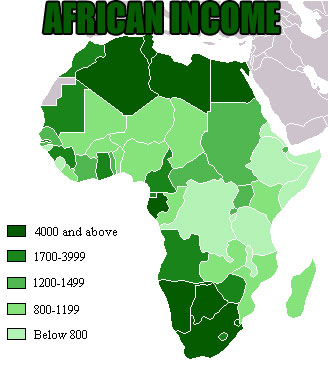
If we “fix” Africa by remaking America, we’re making things worse. Africans do not need to “upgrade” to a culture where everyone has to compete for meaningless jobs in order to get food and shelter. True wealth is an abundance of resources, knowledge and time.
I don’t want to make this sound like us genius and enlightened first world crackers need to bless the Third World with our profoundly cool-looking ideas. This is a two-way conversation. Frankly, the Third World has a lot more to teach us, in terms of useful skills for the future. I’m not a Luddite, though—just saying we need to figure out a more efficient and less polluting method for manufacturing cell phones.
Africa’s future, for better or worse, is in mobile communications technology. For a detailed and visionary look at the potential of this emergent system, I highly recommend Erik Hersman’s PDF report on The Africa Network.
Further Reading for Curious Primates
If this sounds authoritative, don’t be fooled: I’m still just beginning to learn about this and I’ve never even been to Africa. I left out 10,000 things.
For a weeklong overview of sustainable ecology in one sentence format: check out John Todd, Open Source Ecology, Movement as Network, Amory Lovins, Rocky Mountain Institute, Bill Mollison, Permaculture, Appropedia. I also highly recommend the book Worldchanging it’s currently 8 bucks on Amazon and it’s over 500 pages of portable inspiration and brainfood.
I’ve mentioned Erik Hersman twice already. He’s also the mind behind one of my favorite websites right now: Afrigadget, “about low-tech ingenuity and microentrepreneurs in Africa.” One of the most inspirational and thought-provoking finds I’ve made in 2008, by far.
The soundtrack to writing this article: Ali Farka Toure, Amadou et Mariam, Tinariwen, Oumou Sangare and of course some Toubab Krewe.
Recommended Reading
- Liber Null & Psychonaut by Peter J. Carroll
- Coup d’Etat by Edward N. Luttwak
- Worldchanging by Alex Steffen
- The Revolution Will Not Be Microwaved by Sandor Ellix Katz
For more recommendations please visit our Store.
- 2012 Reading List: Year of the Jellyfish
- The Brainsturbator 2011 Reading List
- The 2010 Brainsturbator Reading List
- The Greatest Achievement of Organized Science
- Tracing Our Own Constellations
- Psychic Warfare from 1981-2008
- Bucky Fuller & his World Game: Intro to Saving Planets
- Saving the World Starts in Africa
- The 2008 Brainsturbator Update: Back to School
- The Mind of Tony Smith: A Guided Tour
- "Minds to Pay Attention To" via Sean McBride
- lol, I found brainsturbator in the lulzsec irc leaks
- DARPA Contest: The Logistics Getting Humans to Alpha Centauri
- The Very, Very Strange Properties of REM Sleep
- The Deep Structure of Our Internets
- Feeding the World: Global, Urban, Individual
- From Spam Factory to Time Capsule
- The Red Book (Jung)
- Brainsturbator Tumblr is up and running again
- Sonofusion is the Superforce
Brainsturbator on Twitter
For more updates follow Brainsturbator.
Brainsturbator Favorites
-
Meta
-
The Abyss
-
Aikido Activist Anarchy
-
Weird Science
- The Mind of Tony Smith: A Guided Tour
- Networks, Bacteria, and the Illusion of Control
- The Quest for the Elusive Chronon
- Our Fractal Universe: A Sneak Peek at the New Cosmology
- More Chronon Theory: Jacques Vallee’s “Associative Universe”
- Get In Tune With Chronobiology: Part One
- “Sense of Wonder” Maintenance, Round 2
-
We Salute You

19 responses to "Saving the World Starts in Africa"
Oct 28, 2008 at 7:17 AM
Chris says...
As always, your blogs are incredibly inspiring!
Oct 28, 2008 at 9:23 AM
Bryan Berndt says...
http://maybememe.newsvine.com/_news/2008/09/29/1929165-eat-the-light-the-fourth-age-of-solar-commences-
Africa = Solar Rich
Unfortunately, even my friend(quoted in the article) who has 50 million lined up for a solar farm in Uganda can’t get the production time. It’s booked for 2 years. Germany is sucking up 80 percent of the worlds solar production!!
They don’t need it, Africa does.
Oct 28, 2008 at 9:53 AM
TW says...
This was a somewhat interesting, although ultimately anticlimactic, piece. At the end of the day, you don’t really define (to my satisfaction) WHY Africa needs an alternative development model (compared to the West) or WHAT such a development model would look like. Throwing around terms like “self-sufficiency” and “learning useful skills,” is all fine and good; I’m supportive of that. But what does that mean practically? Ultimately, the best way for the world’s poor to rise economically is through government enforcement of private property rights (see Hernando Se Doto’s book, “The Mystery of Capital: Why Capitalism Triumphs in the West and Fails Everywhere Else").
Oct 28, 2008 at 10:52 AM
thirtyseven says...
^^Thank you for that—that’s exactly what I’ll need to address next.
Oct 28, 2008 at 11:18 AM
Tendo says...
Excellent article as always! I really enjoy your blog.
Oct 28, 2008 at 11:23 AM
TW says...
Cool. Looking forward to it.
Oct 28, 2008 at 12:53 PM
Skeptikos says...
I wish people would stop invading Somalia, just for a decade or so, so that we could have a fair test of anarchism. It was apparently performing pretty respectably before the heavy warfare of the last few years.
All in all, I agree with the post, except for the jobs part. If an African is willing to work at a particular job, why shouldn’t we let him? If he had some better job to work at, surely he’d be there instead, right? I don’t see how restricting job choices could possibly make anyone better off. As much as you may dislike money and the rat race, I think we should let each African make that decision himself. It seems to be working well enough in India… and Taiwan, Singapore, Hong Kong, Dubai…
Oct 28, 2008 at 2:25 PM
Khanverse says...
Great!
http://www.modernghana.com/newsp/166095/1/pageNum1/k-b-asante-ghana-can-and-should-feed-herself.html
Oct 28, 2008 at 3:24 PM
thirtyseven says...
Skeptikos, I have grave reservations about who jobs in India, Singapore, Taiwan, etc., are really “working” for. Jobs that don’t pay fair wages, jobs that provide steep profits to international corporations, jobs that damage the worker’s health and pollute their communities...those are not good jobs.
Even here in the US, people aren’t working jobs because they want jobs—they’re working in exchange for resource tickets.
Those of us lucky enough to have meaningful work would still be doing meaningful work if we didn’t need resource tickets to get food, water and shelter. A meaningful life in a thriving community is the best example of a “good job” I can think of.
Oct 28, 2008 at 8:26 PM
LaZ says...
this is awesome.
exactly what i needed to read.
Oct 28, 2008 at 10:24 PM
Skeptikos says...
I just can’t agree with that. It contradicts all sorts of basic economics.
Bad jobs are better than worse jobs (or no jobs). And the people in the best position to decide which jobs are better are the Africans themselves. Like Paul Krugman writes.
We might have to agree to disagree here.
Oct 30, 2008 at 8:50 AM
Cortney says...
I am an American studying in South Africa right now. This article summarizes EXACTLY what I have experienced while being here. Kudos go to you.
About the job post-you must understand what has happened here in South Africa to understand why jobs are not the “cure”. Black and Coloured people here are just coming out of Bantu education, exploitation, and not to mention The Apartheid. Simply offering jobs does almost nothing for people who don’t know how to read or write.
Oct 30, 2008 at 11:47 AM
MalaKai says...
very uplifting article man.
Nov 07, 2008 at 7:46 PM
earthbound mammal says...
Anarchism seems to me not a way of politics to be enforced but a realisation about the nature of power and freedom. Africa: different situations require different solutions. Western technofascism is not desirable here or there. I’m sure Africans can sort out their own issues without enforced western models, but hopefully they’ll smash and grab our idea supermarket for anything of value they can find. I’ll be happy to help out if i can but the motivating force for solutions must surely come from the people in the situation; i.e. those that truly understand it and will be implementing the solutions and living with the situations.
Also, we’re about to face a bunch of significant challenges that will probably put a massive damper on that enthusiasm for “western civilisation.”
Hopefully we can reach that treasured realm where humanity is a steady state sub-system of the planet.
Nov 11, 2008 at 10:31 AM
nathan says...
The question is… would you work the same hours in a “meaningful” job if you didn’t live in a society where jobs were the only access to “resource tickets”?
i take a different view of the economics.
meaningless jobs are good to the extent they let workers increase their productivity *and* the workers have access to a true market to sell their capital. this isn’t the case in the U.S., where only 1 in 50 couples/families manages their circumstances such that one of the heads of the household can work only part-time--despite American productivity having increased approximately a bajillion times (a unscientific figure) in the past century, i.e., enough that we could take 6 months out of the year off and still have post-WWII levels of production. In America we’ve chosen consistently to use our productivity to buy more shit, rather than to take time off. I mean I like microwaves, but is it worth living in a society where the only jobs available require you to work 14 hours a day because all your co-competitors for jobs want to work those hours to get a stainless steel 5000 watt SuperCook Microwave or whatever? Is it possible to live in a society where it’s feasible to have that choice? Because while it may be for individuals--there will always be self-centered assholes who think their ability to succeed means everyone can do just what they have, and likewise, underachieving part-time losers--it doesn’t appear to be for society at large
Now, I’ve said, “America” a lot and this is about Africa. But i’m using the US to show how the problem is more than just “meaningless” jobs…
that said Africa could also use governments that work, and an end to Anglo-American colonialism disguised as “Free” Trade, but looks like that’s on the way anyway
Nov 11, 2008 at 10:34 AM
thirtyseven says...
We could use “a government that works” here in the US, too, but it’s been a couple hundred years so far and it just keeps failing bigger and increasing the body count.
I don’t think government is a solution to anything, but it’s a great problem generator.
Nov 11, 2008 at 1:28 PM
nathan says...
all societies have some form of government. even anarchocommunist hunter-gatherers have individuals who function as arbiters. And general market/trade conditions require some basic amount of regulation, rule of law and safety. of course that is no gurantee, since the organizing princibles for societies seem to rely heavily of violence against internal and external threats, or physical depravation of members who’ve broken the rules.
so it’s not going anywhere. maybe it will be supplanted by some new structure, but i suspect it will be more of an additional structure on top of the old one. E.g., the way a right-wing “deep state” rose to exert control in the US after the 1960s without dissolving or even replacing the more public structures, at least not initially.
it might also be the case that Africa becomes a “rhizomatic” society, but I tend to think the flip-side of that utopian ideal is open source tribal warfare
and I tend to think that many problems don’t need solutions so much as the removal of problems--i.e., the cure is not some entrepenurial action, so much as it is a reaction against something. I tend to think that a place like Africa, however, being relatively un-developed, does need “solutions”. e.g., hookworm but it also needs non-market conditions to back those.
More generally, we can all cheerlead over electric cars, etc., but might it not make more sense to revitalize public infrastructure and urban design?
Nov 11, 2008 at 5:34 PM
Jon Storvick says...
hell yeah, dude. Exactly the headspace I’ve been in… I just changed my major to Sustainable Community Development, and will be taking the Permaculture Design Course this next summer.
Jon
Nov 12, 2008 at 7:50 AM
Robin says...
Hi Justin,
Great article. Positive, informed, authoratitive and friendly. Thankyou.
Peace
R.Goodfellow